Why Custom Report Writing Still Requires Human Expertise in the Age of AI
Artificial intelligence is becoming part of nearly every business conversation. Organizations are using it to draft content, summarize information, write code, and analyze data. That progress is real, and AI can be useful in custom reporting work.
But useful is not the same as reliable enough to replace an experienced report writer.
That distinction matters because a custom business report is not simply a table of fields or a chart generated from a prompt. A dependable report must reflect how the organization actually operates, how its systems store information, how business rules are applied, and how the final output will be used to make decisions.
Recent research on AI-assisted technical work reinforces that point.
A Current Reality Check on AI Productivity
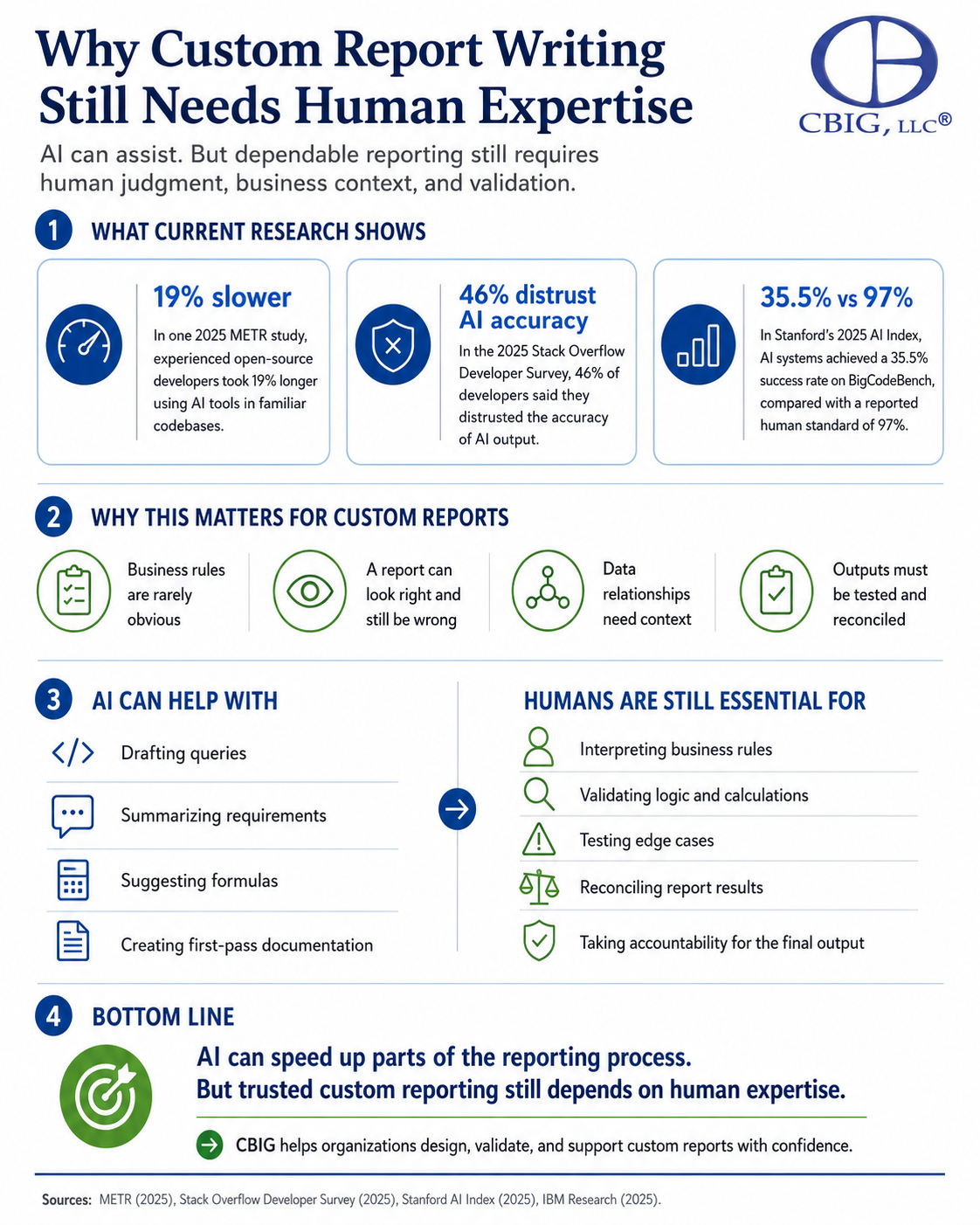
In a randomized controlled study published by METR in July 2025, experienced open-source developers working in codebases they already knew took 19% longer when they used early-2025 AI tools. The developers had expected AI to make them faster, but the study found the opposite in that specific setting. METR has since noted that the result reflects a particular moment in AI development and should not be generalized to every task, but it remains an important example of the gap between perceived efficiency and measured results. (Metr)
The 2025 Stack Overflow Developer Survey found a similar tension between adoption and trust. AI use among developers remained widespread, but 46% of respondents distrusted the accuracy of AI output, compared with 33% who trusted it. Experienced developers were the most cautious, underscoring the continued need for human review when the work carries operational responsibility. (Stack Overflow Insights)
Stanford’s 2025 AI Index also showed both sides of the story. AI performance improved rapidly on many coding benchmarks, yet on the more demanding BigCodeBench, AI systems achieved a 35.5% success rate, compared with a reported human standard of 97%. (Stanford HAI)
The takeaway is not that AI has no value. It is that strong benchmark performance or a fast first draft does not guarantee a correct, production-ready result.
Why Custom Reports Are More Complex Than They Appear
A request may sound simple:
“Build a report showing overtime by department.”
An AI tool may be able to generate a query, suggest a layout, or identify possible fields. But before that report can be trusted, someone still has to answer questions such as:
Which labor account or organizational field defines the department?
Does “overtime” mean a specific pay code, an overtime rule, or hours above a threshold?
Should transferred employees appear under their home department or worked department?
Are corrections, retroactive changes, and historical effective dates included?
Which population should be excluded?
Does the report need to reconcile with payroll, finance, or another source?
Those are not merely technical questions. They are business-rule questions.
A human report writer works with stakeholders to uncover those rules, test assumptions, identify exceptions, and confirm that the final result reflects the organization’s actual processes.
AI can generate syntax. It cannot independently know which interpretation the business intends unless that context has been clearly documented, supplied, and validated.
The Risk of a Report That Looks Right
One of the greatest reporting risks is not an obvious error. It is a polished report that appears reasonable but is subtly wrong.
A report can run successfully and still:
use the wrong effective-dated record;
double-count employees with multiple assignments;
omit historical adjustments;
join two data sources at the wrong level;
apply the wrong date range;
confuse scheduled hours with worked hours;
include inactive employees;
misstate totals because of rounding or aggregation logic.
AI-generated work can make these risks harder to detect because the output may be well formatted and confidently presented.
IBM researchers reviewing 120 AI-agent evaluation frameworks emphasized the importance of examining the intermediate steps used to reach an answer, not just whether the final answer appears correct. Their review also noted that the strongest agents can still perform poorly on more complex real-world tasks. (IBM Research)
That principle applies directly to custom reporting. A trustworthy report requires traceable logic, test cases, reconciliation, and documented assumptions.
What a Human Report Writer Contributes
An experienced report writer does more than build the report.
They translate business language into system logic. They know what questions to ask when requirements are incomplete. They understand that two fields with similar names may represent very different concepts. They recognize when a request conflicts with the underlying data model. They test exceptions rather than only the easiest example.
Most importantly, they accept responsibility for validating the result.
A strong custom reporting process typically includes:
Requirements discovery
Understanding the business question, users, timing, filters, and expected outcome.Data-model analysis
Identifying the correct sources, relationships, effective dates, and field definitions.Business-rule translation
Converting operational policies into accurate report logic.Development and testing
Building the output and testing normal cases, exceptions, transfers, retroactivity, and edge conditions.Reconciliation
Comparing results against trusted sources such as payroll, finance, or established reports.User validation
Confirming that stakeholders understand and approve the logic.Documentation and support
Recording assumptions and maintaining the report as systems and business rules change.
AI may help accelerate portions of that work, but it does not remove the need for it.
The Best Use of AI in Custom Reporting
The most practical approach is not “AI versus humans.” It is AI used under experienced human direction.
AI can help with:
drafting query structures;
suggesting formulas;
explaining unfamiliar syntax;
creating test scenarios;
documenting logic;
identifying possible performance improvements;
summarizing requirements;
generating an initial prototype.
The human remains responsible for:
selecting the right data;
interpreting business rules;
protecting sensitive information;
validating calculations;
testing exceptions;
confirming compliance;
approving the final output.
That combination can improve efficiency without sacrificing accuracy.
When the Report Matters, Expertise Matters
Organizations rely on reports to make payroll decisions, manage labor, monitor compliance, control costs, plan staffing, and evaluate performance. In those situations, “mostly correct” is not good enough.
AI can produce a fast answer. A skilled report writer produces an answer the business can defend.
As AI tools continue to improve, they will become increasingly valuable within the reporting process. But the work that makes a report trustworthy, context, judgment, validation, accountability, and an understanding of the business, still depends on experienced people.
At CBIG, custom reporting is built around the business question, not just the available fields. Our team works with clients to understand requirements, translate complex workforce and operational rules, validate the underlying data, and deliver reports that decision-makers can use with confidence.
Need a custom report that accurately reflects how your organization operates? Contact CBIG to discuss your reporting requirements and challenges.