
Why Poor Workforce Reporting Is Costing You More Than You Think
Workforce management systems are designed to make operations more efficient. They support payroll, scheduling, timekeeping, labor tracking, compliance, and reporting. But when the reporting behind those systems is inaccurate, incomplete, difficult to access, or too manual, the entire organization can feel the impact.
For many organizations using UKG Pro Workforce Management or UKG Workforce Central™, reporting challenges do not always appear as one major system issue. Instead, they show up in smaller, recurring problems:
Payroll teams spend extra time validating hours.
Managers question whether labor reports are accurate.
Operations teams lack visibility into scheduling and coverage.
Finance teams struggle to trust labor cost data.
Leadership does not have a clear view of workforce trends.
Over time, those issues create delays, manual work, frustration, and unnecessary risk.
Workforce Data Is Only Valuable If You Can Use It
UKG applications contain valuable workforce data, but that data needs to be accessible, accurate, and organized in a way that supports real business decisions.
A standard report may answer a basic question, but many organizations need more than standard reporting. They need reporting that reflects their specific pay rules, labor structure, departments, schedules, exceptions, union rules, agency usage, approval processes, and payroll requirements.
That is where custom UKG reporting becomes important.
Custom reporting helps organizations take the data already available in their workforce management system and turn it into clear, usable information. The right report can help payroll validate time faster, managers identify exceptions earlier, operations teams monitor staffing, and leadership understand labor trends before they become larger problems.
Common Signs Your UKG Reporting Needs Attention
Many reporting issues are easy to overlook because teams become used to working around them. If your organization is relying on manual checks, spreadsheets, or repeated data validation outside of UKG, your reporting process may not be supporting your team as well as it should.
Common signs include:
Payroll reports require too much manual review before processing
Different teams are using different versions of workforce data
Reports do not match what managers expect to see
Labor distribution reporting is difficult to validate
Scheduling, overtime, or exception data is hard to track
Existing reports are outdated or no longer aligned with business needs
Internal teams depend on one or two people to pull critical reports
Leadership lacks clear visibility into workforce trends
Reporting issues are delaying payroll, finance, or operational decisions
These challenges are not just reporting problems. They are business process problems.
Better Reporting Improves More Than Visibility
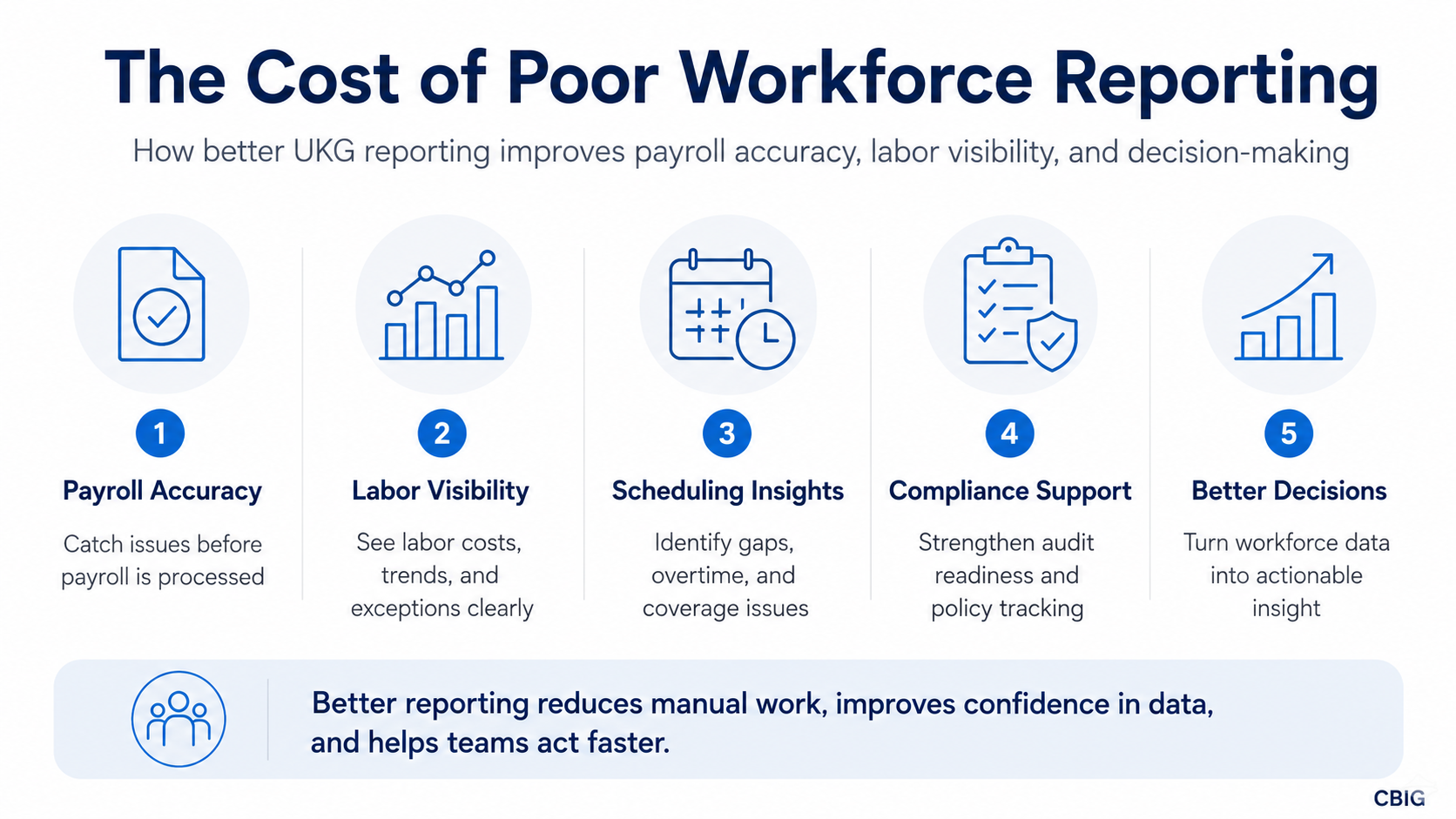
Strong UKG reporting can improve accuracy, reduce manual work, and help teams make decisions with more confidence. When reporting is designed around how the organization actually operates, it can support multiple teams at once.
For payroll, better reporting can make it easier to identify missing punches, unapproved timecards, exceptions, overtime, and pay code issues before payroll is processed.
For operations, reporting can provide better visibility into staffing levels, scheduling trends, coverage gaps, and labor utilization.
For finance, reporting can support labor cost analysis, department-level visibility, agency usage, and budget tracking.
For HR and compliance teams, reporting can help support policy review, attestation tracking, audit preparation, and workforce trend analysis.
For leadership, reporting can turn complex workforce data into useful insights that support planning and decision-making.
Why Standard Reports Are Often Not Enough
Every organization has its own workforce structure, pay practices, approval workflows, reporting requirements, and operational priorities. A report that works for one organization may not work for another.
Standard reports can be helpful, but they may not answer the questions your teams ask every day. They may not reflect your exact labor categories, approval process, schedule structure, payroll rules, or business reporting needs.
Custom UKG reporting helps close that gap.
A well-designed custom report should not just pull data from the system. It should help answer a real business question, such as:
Are all timecards ready for payroll?
Which departments are driving overtime?
Where are exceptions creating delays?
Which employees have unapproved time?
How is labor being distributed across jobs, departments, or cost centers?
Are schedules aligned with actual worked hours?
What data needs to be sent to payroll, finance, agencies, or other systems?
When reports are built around business needs, they become tools that help people work more efficiently.
Reporting Problems Can Signal Larger System Issues
Sometimes a reporting issue is not really a reporting issue. It may point to a deeper configuration, process, integration, or data quality problem.
For example, if a payroll report does not look right, the root cause may be related to pay code setup, work rules, employee assignments, labor account configuration, timecard approval processes, schedule data, or integration logic.
That is why effective UKG reporting support requires more than report development. It requires an understanding of how workforce data moves through the system and how that data supports payroll, scheduling, operations, finance, and compliance.
The best reporting solutions come from understanding both the technical structure of UKG and the business process behind the report.
How CBIG Helps Organizations Improve UKG Reporting
CBIG helps organizations design, build, troubleshoot, and optimize custom reports across UKG Pro Workforce Management and UKG Workforce Central™ environments.
Our team supports reporting needs related to payroll validation, timekeeping, scheduling, labor distribution, exceptions, agency reporting, integrations, compliance, and executive visibility. We work with organizations to understand what they need from their workforce data, where current reporting is falling short, and how reporting can better support day-to-day operations.
CBIG combines UKG application expertise, technical reporting knowledge, and practical workforce management experience to help organizations improve reporting accuracy, reduce manual work, and gain more confidence in their data.
Better Reporting Creates Better Workforce Decisions
Workforce management data should help your organization move faster, operate more efficiently, and make better decisions. When reporting is difficult to access or hard to trust, teams lose time and confidence.
With the right UKG reporting strategy, organizations can improve payroll accuracy, strengthen operational visibility, reduce manual effort, and get more value from their UKG investment.
If your team is spending too much time validating reports, reconciling data, or working around reporting limitations, it may be time to take a closer look at your UKG reporting environment.
CBIG can help you turn complex workforce data into clear, actionable reporting that supports your business.